
Lihexing's vision software platform is fully self-developed by our in-house software team, refined and iterated across hundreds of real production-line projects. It is a truly full-stack machine-vision platform born on the shop floor — from the core algorithm engine and inspection-logic orchestration to HMI, data reporting and production-line communication, the entire chain is independent and controllable, with no reliance on any single external software stack. The platform integrates 100+ highly encapsulated operator modules covering mainstream industrial needs such as positioning, classification, surface-defect inspection, precision measurement and 3D reconstruction, and supports hybrid modeling across 1D/2D/3D and deep learning for a standardized, process-oriented and orchestrated vision development paradigm.
Fully Self-developed Algorithm Engine, Deeply Controllable Capability
The vision algorithm engine is the company's core self-developed asset, built up through long-term accumulation. It integrates mainstream image-processing theory with years of on-site engineering experience across the lithium-battery, hygiene-product and automotive industries, and its accuracy and stability have been repeatedly proven across hundreds of delivered projects. The engine provides nine algorithm modules with dozens of operators — image calibration, 2D/3D locating, precision measurement, image stitching/fusion, preprocessing, defect inspection, 1D contour analysis and 3D point-cloud analysis — and supports custom algorithm development for complex on-site conditions, delivering micron-level inspection accuracy and long-term stable operation.
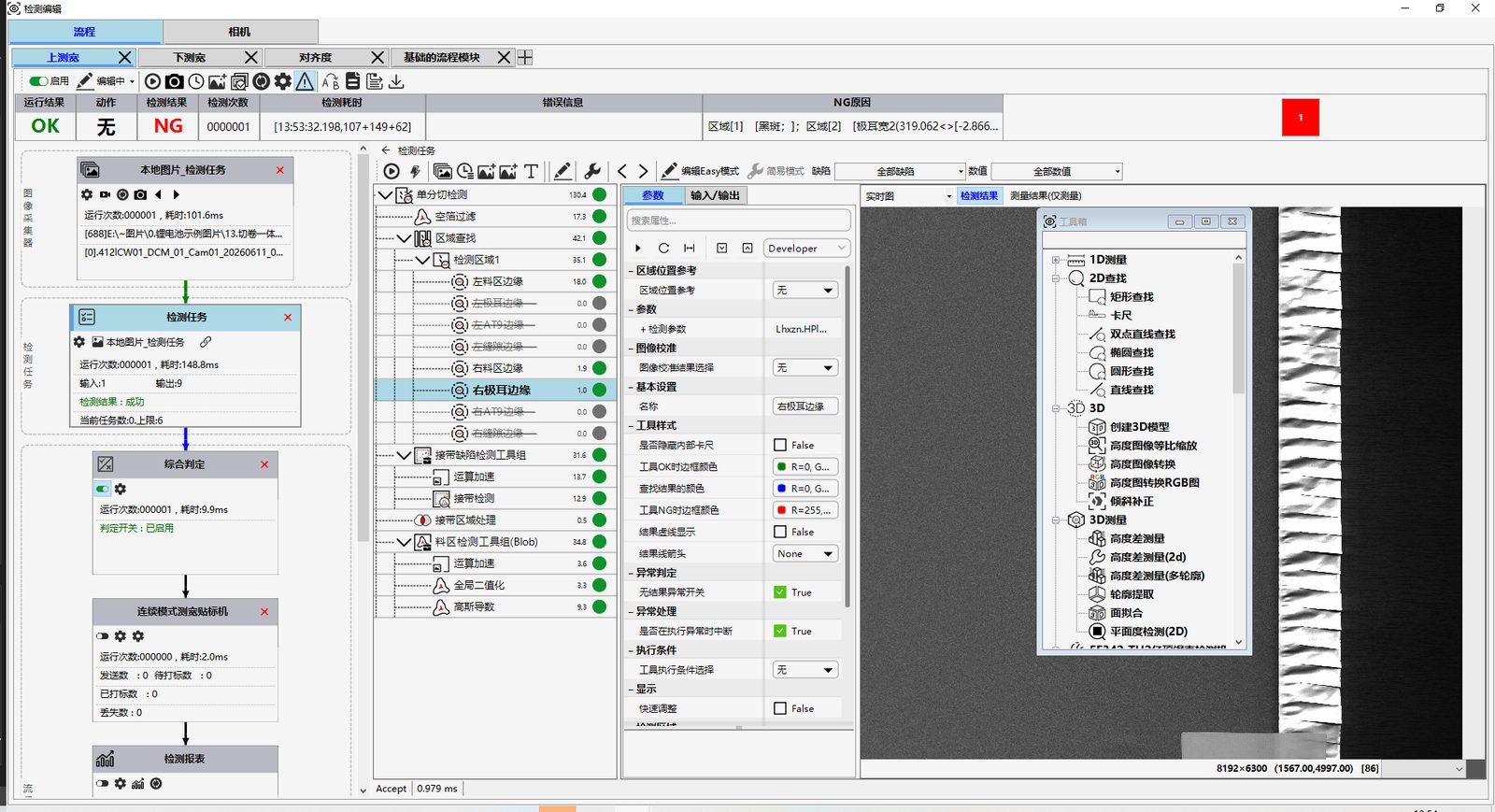
Zero-code Visual Development, Faster Delivery
The platform abstracts complex vision engineering into intuitive graphical operations: algorithm flows are configured by drag-and-drop with zero coding, and inspection items can be adjusted quickly to customer requirements. The main UI supports 0-code free composition with one-click layout switching per product model, and includes common widgets such as line charts, roll charts, defect walls and data tables. Process logic such as result judging, value calculation, marking/ink-jet, report, image and data storage is configured in modules, greatly shortening project delivery cycles and enabling line-side staff to maintain the system independently.
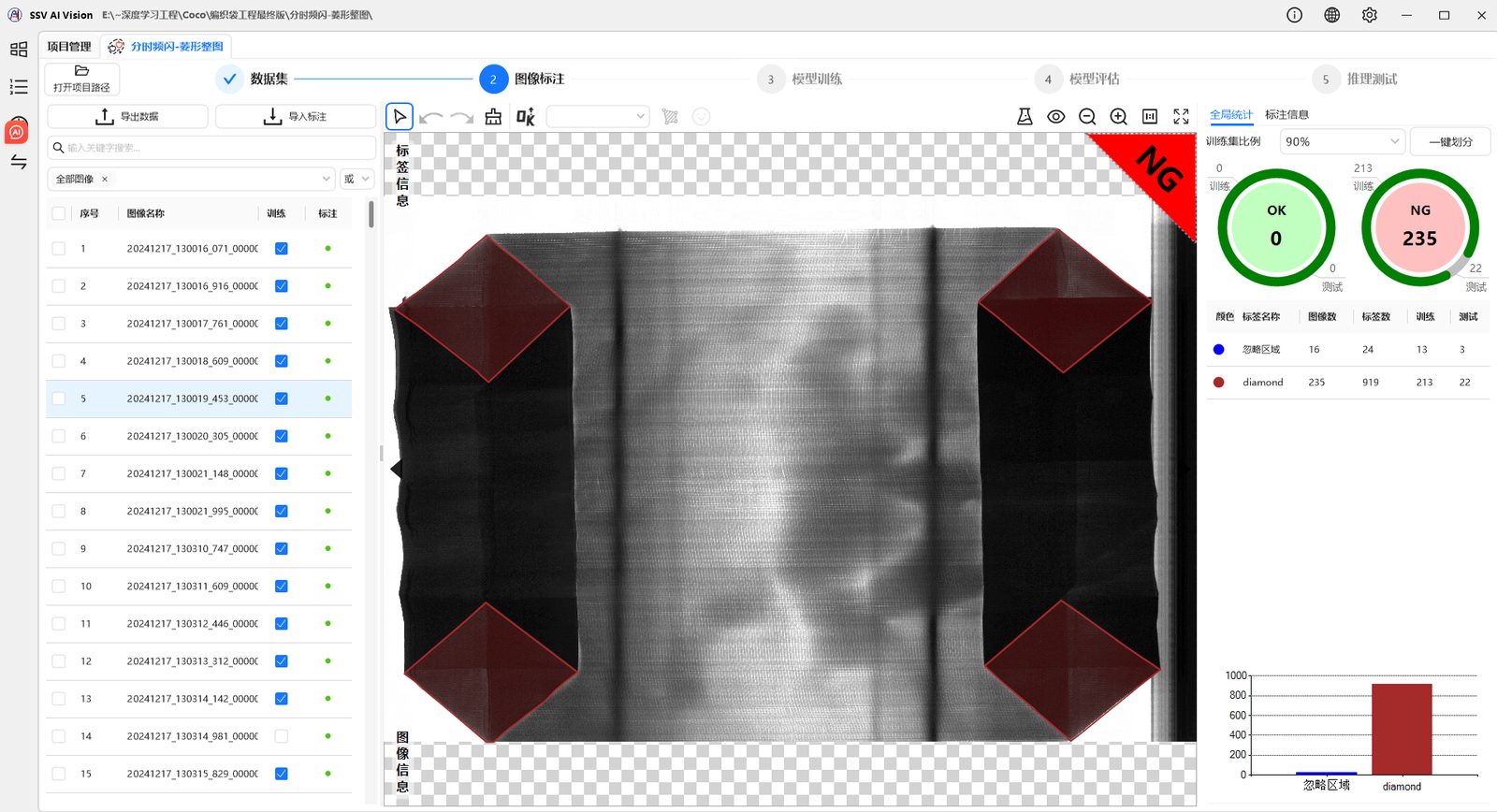
Industrial-grade Deep-learning Technology Stack
To tackle increasingly complex non-regular defects and difficult target recognition in industrial scenes, the company has built a three-in-one deep-learning path of “industrial large model + domain fine-tuning + lightweight deployment”. Pretrained on hundreds of thousands of industrial images in core scenarios such as lithium batteries, it supports seven task types — semantic segmentation, instance segmentation, rotated-object detection, object detection, OCR, unsupervised learning and classification. Through structured pruning and quantization compilation, model size is reduced by over 80% and inference reaches tens of milliseconds, balancing accuracy with production-line takt time.
Seamless Connectivity Across the Production Line
The platform provides comprehensive production-line communication and data capabilities: it supports IO, TCP, UDP, Modbus, FTP, serial and HTTP, covers mainstream PLCs including Siemens, Mitsubishi, Omron, Keyence and Xinje, and enables remote collaboration between multiple industrial PCs plus light-source control. Inspection data is uploaded in real time with automatic report generation, helping customers close the quality-data loop for full traceability — making “inspection-as-prevention, data-as-asset” a reality.
Self-developed Ecosystem, Rapid Response to Industry Needs
Thanks to an independent and controllable software architecture and deep industry expertise, we can quickly develop custom inspection solutions for specific processes such as coating, slitting, die-cutting, winding and stacking, delivering one-stop integration from hardware selection to algorithm tuning. An internal server cluster supports large-scale training while local machines handle model fine-tuning, ensuring efficient GPU allocation and rapid, continuously improving responses to every new requirement.